
Reward board for siblings without a point system.
This is how you create a shared reward board for siblings, without balance, age, or different tasks turning into a competition.
Published September 13, 2026 · Gatherheart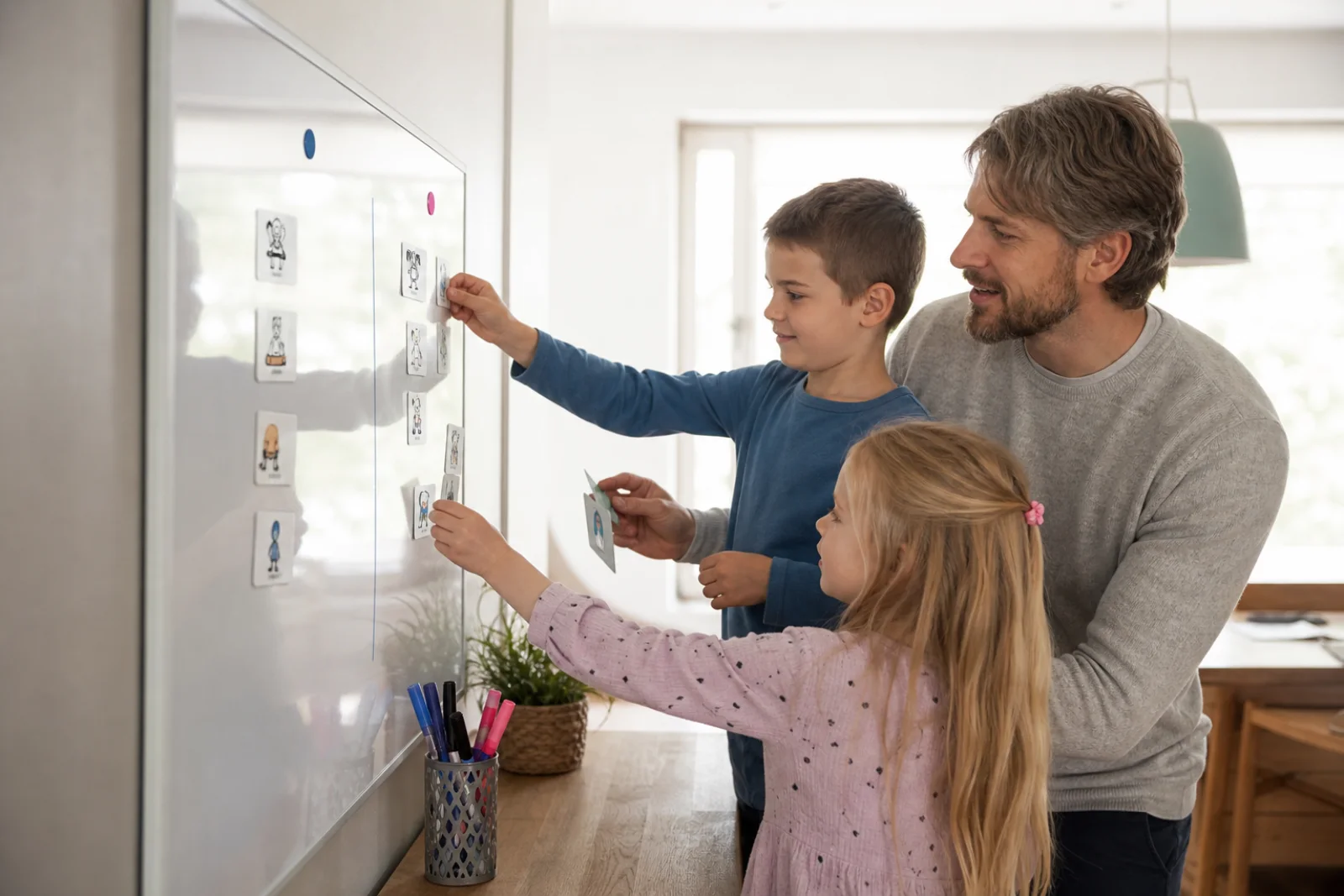
When two children share a reward chart, differences quickly become apparent. The older child can handle more challenging tasks, while the younger child has more opportunities for small achievements. If the chart is presented as a ranking system, it can create exactly the conflict it is meant to reduce.
A good sibling chart therefore shows personal progress and shared contributions without making the children adversaries.
In a nutshell: a reward chart for siblings.
A sibling reward chart can hold personal tasks, individual balances, and a shared goal. Fair doesn't mean identical requirements. It means that each child has a realistic path to contribute and achieve attractive rewards at their developmental stage.
The most important thing is that the solution is experienced as support and clarity – not as a judgment on the child. A board or app can make expectations visible, but the relationship, the help, and the concrete recognition are still what make everyday life work.
Why this method can be suitable for a busy family
The model works well when children have different ages, energy levels, or skills. It can also be used for collaborative tasks where points are shared. The key is for adults to avoid comments like "look at how many your brother has" and instead focus on the individual's agreement.
A good arrangement also makes it clear what the adults are responsible for. Children should contribute at a level that matches their age, energy, and skills; they should not bear the burden of the family's operations. If you are unsure about the level, you can start with our guide to peer cooperation without point competition and age-appropriate tasks.
How to set it up
Start small and agree on when to review the arrangement again. Use these steps as the first version:
-
Assign personal tasks based on age and ability.
-
Keep individual balances private or neutral.
-
Add one common goal that everyone can contribute to.
-
Share points for genuine collaboration.
-
Celebrate concrete actions rather than placements.
Write the task as a visible action. "Help more" is difficult to succeed with, while "put your plate in the dishwasher after dinner" can be understood and completed. Also, choose who approves and whether the child marks the task as completed themselves.
An example from a typical week
A 7-year-old serves for 1 heart, while a 12-year-old makes salad for 2. Both can help clean out the basement, where 4 hearts are shared among the participants. Each child has their own small wishes, and the whole family can donate for a Sunday outing.
The example shows why an electronic reward chart can be practical: repetitions, points, and common goals can be kept together without an adult having to draw a new chart every week. However, the digital solution should be short on the screen. The child should be able to see the next action, record it, and return to everyday life.
Balance between reward and intrinsic motivation
Children don't need to earn the same amount every week. School, leisure, and extra time vary. Instead, look for whether both are experiencing a clear opportunity to participate. If one always runs away from the other, you can adjust tasks or goals without resetting any points already earned.
Therefore, also talk about the impact: Who was helped? What became easier? What did the child learn? When points are accompanied by such a conversation, the reward becomes a visible sign of effort rather than the whole reason for helping.
Common mistakes you can avoid
-
Displaying a consolidated winner list at home.
-
Giving the same task value despite very different efforts.
-
Forcing a child to share personal points.
-
Allowing speed to be more important than collaboration.
If the system leads to more discussions than before, it's a sign to simplify it. Remove tasks, temporarily lower the requirements, or let the child choose a new reward. A reward system is a tool, not an agreement that must never change.
A simple evaluation after seven days
Set aside ten minutes and ask: Could the child see what needed to be done? Was the task realistic? Was the recording remembered? Was the reward attractive without being excessive? Keep what worked and only change one thing at a time. Then you can see which change actually helps.
Frequently Asked Questions
Should siblings receive the same rewards?
No. Personal preferences can vary, but the point system should feel fair.
How are points shared through collaboration?
Before the task, agree on how to divide the work. The system can divide it equally, or an adult can adjust it by assigning clearly different roles.
Can the children see each other's balances?
Yes, if it doesn't create a comparison. Otherwise, each balance can be displayed on the child's own profile.
Next steps
Choose one specific situation from the upcoming week and create the simplest version of a sibling reward chart. Once it works consistently, you can add another task or a shared reward. Hjerterum allows you to collect tasks, hearts, and rewards digitally, but the foundation remains the same: clear expectations, appropriate responsibilities, and warm recognition.