
Pet care tasks teach children about care in practice.
Food, fresh water, and calm routines around the family’s pets can make care more tangible—when the adult continues to bear the ultimate responsibility.
Published August 11, 2026 · Hjerterum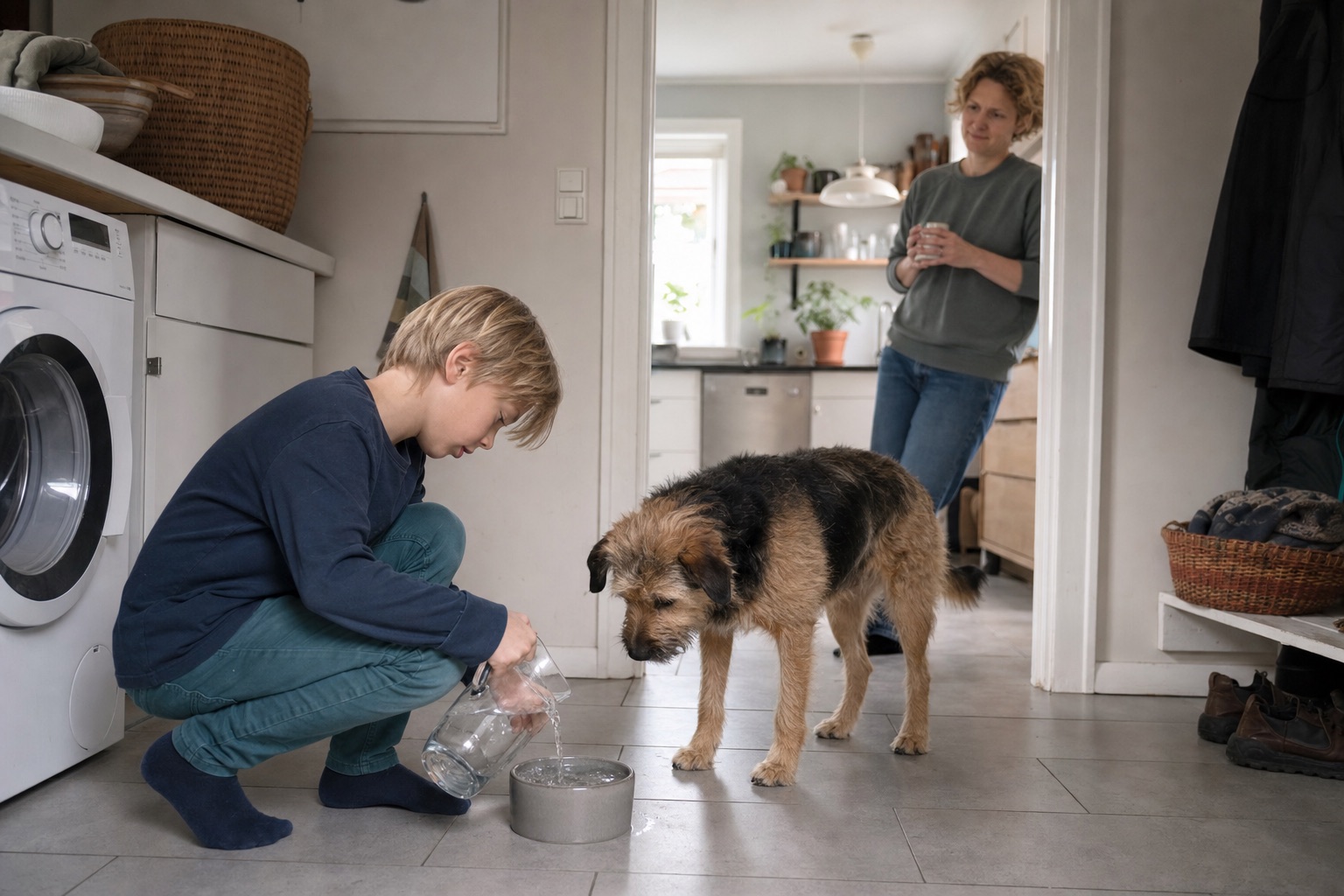
A pet can't wait for the family to have more time. The water needs to be fresh, the food bowl needs to be filled, and the dog needs to go outside, even when it's raining. That's precisely why tasks related to animals are a special kind of shared responsibility: the child's actions have an impact on a living being here and now.
At the same time, it requires a clear adult framework. A child must not be left alone with the responsibility for the animal's well-being. The adult must follow up and intervene if the task is forgotten. The child's role is to provide stable care — not to bear the consequences alone.
Choose the part the child can succeed in.
"Take care of the dog" or "Take care of the cat" are too broad tasks. Break them down into actions that can be seen and completed:
-
fill the bowl with fresh water after breakfast.
-
measure out the agreed amount of food.
-
brush the fur for five calm minutes
-
put the animal's toys back in the basket
-
go on the short evening walk with an adult
An exact task also makes it easier for the adult to ensure that the animal's needs are met without the control feeling like a lack of trust in the child.
Integrate the task into an existing rhythm
Memory is aided by fixed landmarks. Water after brushing your teeth is easier to remember than "at some point in the morning". Feeding before the family eats themselves, or a short walk after dinner, provides the same level of familiarity.
If multiple children share the tasks, make the distribution visible. Otherwise, the classic situation arises where both think the other has done it. Feel free to switch roles from week to week, but avoid daily changes that make the routine difficult to learn.
Teach the child to discover - not just perform.
Care also involves noticing changes. Has the water bowl tipped over? Does the animal seem uninterested in the food? Has the rope broken? The child can learn to tell an adult what they see without having to assess or solve the problem themselves.
Use neutral language if a task is forgotten: "I see the bowl is still empty. The animal needs water now—will you fill it, or should I do it today?" First, the animal's needs must be met. The conversation about the routine can come later.
Recognize reliability over sweetness
It's nice to cuddle with a pet, but the less visible care is often the most important. Tell the child exactly what the contribution means: "You remembered the water all week, so the cat had fresh water every morning." This makes stability visible without romanticizing the responsibility.
In the Hjerterum, each animal task can be placed separately and repeated at the appropriate times. Parent approval is particularly relevant here, as an adult must still ensure that the animal's needs are truly being met.