
Children in the kitchen: Give them a real role in the meal.
When children have a concrete role in cooking, the kitchen becomes a place for collaboration rather than just another task that adults have to handle alone.
Published August 30, 2026 · Gatherheart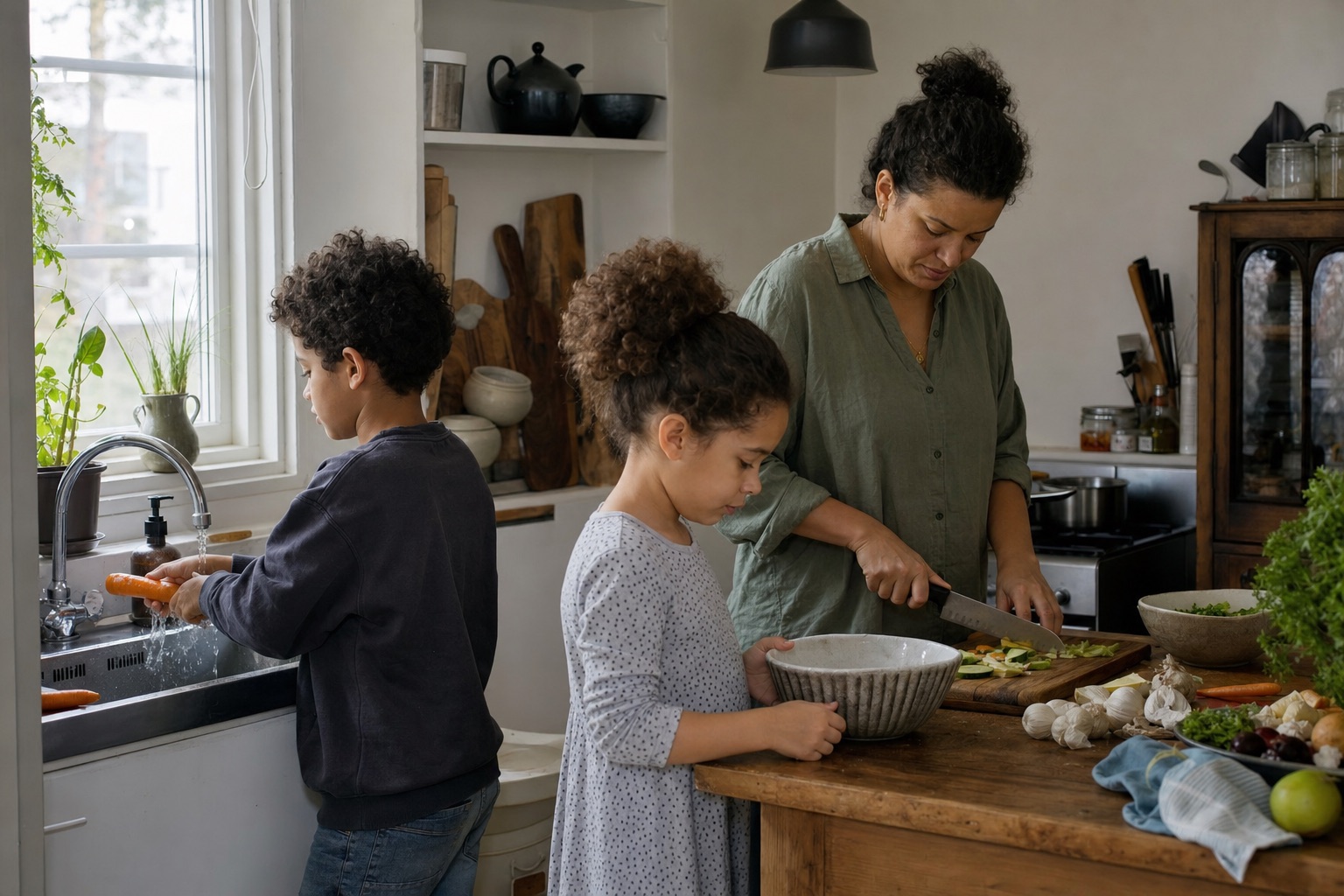
It's tempting to cook the food yourself. It's faster, there are fewer peels on the floor, and the vegetables are roughly the same size. But if children always encounter dinner as something that suddenly appears on the table, they miss the opportunity to experience how many small contributions a meal consists of.
Being in the kitchen doesn't necessarily mean the child is making an entire dish. It can start with washing vegetables, shredding lettuce, setting out glasses, or stirring a cold dressing. The key is that the role is genuine: the family meal actually becomes a little easier because the child is helping.
Give an assignment with a clear conclusion.
"Help with the food" is difficult to grasp. "Wash the six carrots and put them on the tray" has a beginning and an end. When the task is concrete, the child can see when it is completed, and the adult does not need to correct them along the way.
Choose tasks based on the child's experience and kitchen safety. Younger children can count potatoes, fetch napkins, or rinse fruit. Older children can measure ingredients, cut soft raw materials with a suitable tool, or take responsibility for one simple part of the dish.
Make the result look like the child's work.
A crooked slice of cucumber also tastes like cucumber. If the adult immediately changes everything, the child learns that the contribution only counts if it looks like the adult's. Decide in advance what is important for safety and hygiene, and leave the rest to be good enough.
This doesn't mean the child should be left alone with hot pots or sharp knives. The adult is still responsible. The difference is that the help is given as support: "Hold the bowl like this so it stays steady" instead of taking the task out of the child's hands.
Leave room for both pleasure and resistance.
Some days the child wants to participate, while on other days the kitchen feels like just another after-school and extracurricular activity. A sustainable solution has a small version: the child might be content with simply putting water on the table or choosing between two vegetables.
If the family wants to make kitchen help a habit, the role can be rotated. On Monday, one child washes the vegetables, on Wednesday, another sets the table, and on weekends, the family chooses a slightly larger shared task. This way, participation becomes predictable without being fixed.
Discuss the common result
When the food is on the table, point out the connection: "You washed the carrots, and now we're all eating them together." This is more specific than a general "good at it." The child realizes that a small action can be valuable to many people.
In the Hjerterum, you can create the kitchen role as a recurring task with a short description. Feel free to use the name of the task—“Wash vegetables” or “Set the table for four”—instead of a broad category like “Help with dinner.” This makes the task easier to take on and easier to acknowledge.